

Panerai News
Panerai Replica Swiss Movement — What Powers Your Superclone
Mar
Panerai Replica Swiss Movement — What Powers Your Superclone
The movement inside your Panerai reproduction swiss movement watch is what separates a weekend novelty from a daily companion. I’ve opened the casebacks of hundreds of superclones over three decades — from rattling Chinese automatics to Swiss clone calibers that make watchmakers pause and look twice. This guide covers every Panerai replica swiss movement option available right now, what each caliber does, and which one belongs on your wrist.
Why the Movement Matters More Than the Case
A polished case fools the eye. A good dial fools the camera. But the movement — that’s what fools your wrist. Every morning when you pick up your watch, wind it, and feel the resistance through the crown, that’s the movement talking. When you notice your Panerai still running after a weekend off your wrist, that’s the power reserve delivering on its promise. The superclone Panerai watch swiss movement inside a superclone determines accuracy, longevity, and that intangible mechanical satisfaction that makes watch ownership worthwhile.
Genuine Panerai invested years developing in-house calibers — the P.9000 family, the P.4000 micro-rotor, the P.5000 hand-wound series. Superclone factories have reverse-engineered these movements plate by plate, bridge by bridge. The results range from functional copies to near-identical clones that share the same architecture, beat rate, and power reserve as the originals.
Every Panerai Clone Movement — Complete Breakdown
P.9000 Clone — The Foundation
The P.9000 clone is where the Swiss clone Panerai movement story begins. This automatic caliber mirrors the genuine Panerai P.9000 in layout — twin mainspring barrels stacked for 72 hours of power reserve, a bi-directional winding rotor, and 28,800 vibrations per hour (4Hz beat rate).
What you feel when you wind it: smooth, consistent resistance through the crown with no grittiness. The rotor spins freely with a subtle weight shift on the wrist — you notice it when you gesture during conversation, a gentle swing that reminds you the watch is alive. The twin barrels mean consistent torque delivery. Your Panerai homage piece swiss movement keeps the same accuracy at hour 68 as it did at hour 2.
The P.9000 clone lives inside the Luminor collection and select Radiomir models. No date complication, no GMT — just hours, minutes, small seconds, and three days of uninterrupted timekeeping.
Insight: The P.9000 clone’s twin-barrel system isn’t just about power reserve. Twin barrels deliver more consistent mainspring torque across the full 72 hours, which means less accuracy drift as the watch winds down. A single-barrel Miyota loses 5-10 seconds more per day in its final 12 hours of reserve compared to its first 12. The P.9000 clone stays within ±2 seconds across the full three days.
P.9010 Clone — The Modern Standard
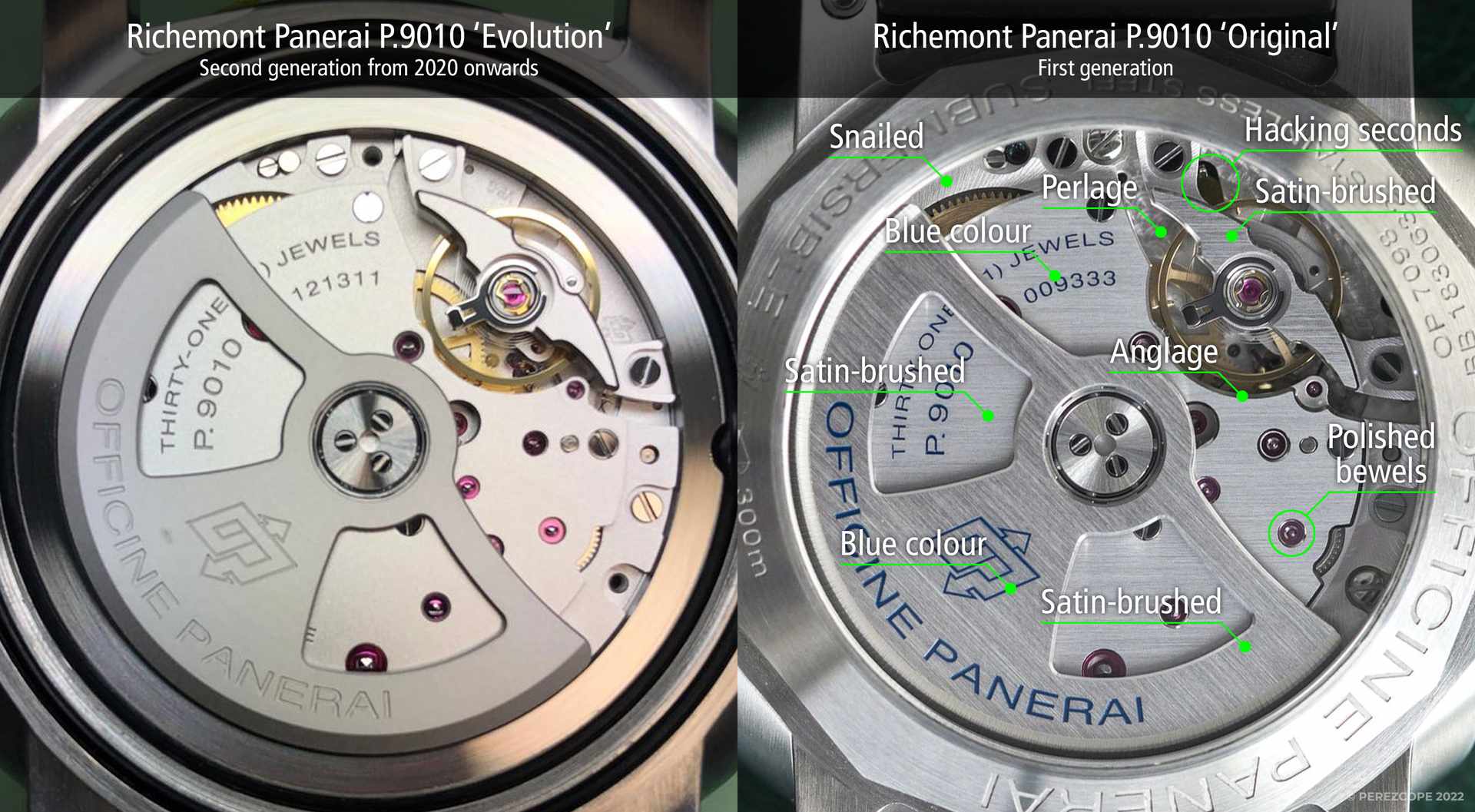
The P.9010 Swiss clone caliber is the most popular panerai replica swiss movement in current production. It builds on the P.9000 architecture but adds a date complication with quickset functionality and shaves roughly 1mm off the movement height — a difference that translates directly to slimmer case profiles.
Pull the crown to position two, and the date window at 3 o’clock advances one day per click. No fumbling past midnight, no waiting for the date to flip at the hour hand passes 12. The quickset mechanism works cleanly on the best Swiss clone versions — crisp clicks, no double-jumping, no date wheel misalignment.
This movement powers the majority of the Luminor Marina line and most Submersible models. The PAM1312, often called the quintessential modern Panerai, runs on a P.9010 clone — and it’s the caliber that most collector forums recommend for a first superclone purchase.
P.9001 Clone — GMT for Travelers
The P.9001 adds a GMT complication to the P.9000 base. An independent hour hand — controlled by a dedicated crown position — tracks a second timezone without disturbing minutes or seconds. Pull the crown one click, rotate, and the hour hand jumps forward or backward independently. The minute hand stays frozen. The seconds hand keeps sweeping.
This is the cloned Panerai swiss movement inside the legendary PAM441 Ceramica GMT. The complication adds one additional gear train and a clutch mechanism, which makes the P.9001 clone slightly thicker than the P.9000. That extra millimeter is invisible inside the 44mm Luminor case but allows genuine dual-timezone functionality.
Tip: Test the GMT hand before accepting QC photos. Ask the seller to demonstrate the independent hour hand adjustment in a short video. On a properly functioning P.9001 clone, the hour hand should jump in crisp one-hour increments without any wobble or ghost movement of the minute hand.
P.4000 Clone — The Hidden Rotor
The P.4000 replaces the conventional full-size rotor with a micro-rotor — a small, weighted semicircle embedded within the movement plates rather than sitting on top. The result: a dramatically thinner movement that allows the Luminor Due line to exist at just 10-11mm case thickness.
Through the exhibition caseback, you won’t see the familiar spinning disc. Instead, a small crescent-shaped weight peeks from beneath the bridges, barely visible — understated and mechanical in the most refined way. The winding efficiency is lower than a full-rotor design, so the P.4000 clone benefits from occasional manual winding if you’re sedentary. But on an active wrist, it maintains its 72-hour reserve without issue.
Swiss Clone vs Japanese Miyota — The Real Difference
The Miyota 8215 has one genuine advantage: decades of proven reliability. Citizen has manufactured millions of these movements, and independent watchmakers can service them blindfolded with readily available parts. The Swiss clone P.9000, while architecturally superior, is younger in production history and uses proprietary parts that require a specialist.
That said — if your Panerai has an exhibition caseback (and most modern references do), a Miyota movement is an instant tell. The layout, rotor shape, and bridge architecture look nothing like a genuine Panerai caliber. A Swiss clone P.9000 or P.9010 matches the genuine visual layout, making it the only viable option for any superclone with a transparent caseback.
Verdict: Choose Miyota only if your Panerai has a solid caseback and you prioritize proven long-term reliability over authenticity. For any model with an exhibition caseback — which includes most Luminor and Submersible references — the Swiss clone is the only serious option.
Movement by Collection — Which Caliber Goes Where
Movement Decoration — What You See Through the Caseback
Flip your Replica Luminor over and look through the sapphire caseback. On a Swiss clone movement, you should see:
Parallel lines machined across the bridges and mainplate. On genuine Panerai, these are deep and mirror-like. Swiss clones achieve 85-90% of that depth. Miyota movements have none.
Genuine uses heat-bluing — slow, hand-controlled heating until the steel turns deep blue. Swiss clones use chemical bluing that achieves a similar color, slightly less depth under magnification.
“OFFICINE PANERAI” engraved on the rotor weight with circular graining on the flat surface. Swiss clones replicate the text and graining pattern. Miyota rotors carry the Citizen logo — an immediate tell.
The edges of each bridge are chamfered at 45 degrees and polished. Genuine Panerai hand-finishes these. Swiss clones machine-finish them — uniform but lacking the subtle hand-worked irregularity that connoisseurs recognize.
How Long Does a Panerai Replica Swiss Movement Last?
With standard care and periodic servicing, a Swiss clone P.9000-series movement runs reliably for 5-10 years. The variables that affect lifespan:
Wearing pattern: Daily wear is actually better for the movement than letting it sit. The oils stay distributed, the mainspring stays exercised, and moisture doesn’t settle. Desk divers who wear their Panerai every day report fewer issues than collectors who rotate five watches.
Shock exposure: The balance wheel and hairspring are the most shock-sensitive components. Dropping a watch onto tile from counter height is the number one killer. An incabloc shock protection system exists in Swiss clones but it’s calibrated less precisely than genuine.
Magnetism: Phone speakers, laptop speakers, magnetic clasps — all enemies of accuracy. A magnetized hairspring causes the watch to run fast, sometimes minutes per day. A degausser tool costs under $15 and fixes this in seconds.
Service interval: Every 3-4 years, have a watchmaker clean and re-oil the movement. This is the single biggest factor in longevity. Dry lubricants cause friction, friction causes wear, and worn pivots cause positional errors that compound over time.
Can You Service a High-end Panerai copy Swiss Movement?
Yes — and this is a common question on watch forums. Any independent watchmaker familiar with ETA-based calibers can service a Swiss clone P.9000. The architecture is conventional: mainspring, gear train, balance wheel, escapement. Standard watchmaking tools, standard techniques.
What to tell the watchmaker: “It’s an Asian clone of the Panerai P.9000.” Most independent watchmakers work with these regularly. They’ll clean the movement ultrasonically, replace worn gaskets, re-oil the jewels, and regulate the timing. A full service typically runs $80-150 depending on your region — far less than the $600+ Panerai charges for genuine caliber service.
Tip: Ask your watchmaker to check the amplitude while servicing. A healthy P.9000 clone should show 260-280 degrees of amplitude on a timing machine. Below 240 suggests worn mainspring or dry pivots. Above 300 suggests the movement is over-wound or has a lubrication issue.
Frequently Asked Questions
What movement does a replica Panerai use?
Top-tier superclones use Swiss clone calibers — P.9000 (automatic), P.9010 (auto + date), P.9001 (GMT), P.4000 (micro-rotor), or P.5000 (hand-wound). Budget AAA replicas use Japanese Miyota 8215 or 82S7 movements. The Swiss clone versions mirror the genuine Panerai caliber architecture, while Miyota is a completely different movement dressed in a Panerai-stamped rotor.
Is a Swiss clone movement better than Miyota?
For accuracy and authenticity — yes. The Swiss clone P.9000 delivers 72-hour power reserve vs Miyota’s 42, keeps time within ±5-8 seconds vs ±10-20, and visually matches the genuine caliber through an exhibition caseback. Miyota’s advantage is proven long-term reliability with decades of production history and easily available spare parts.
How long does a Panerai superclone movement last?
A Swiss clone P.9000-series movement runs 5-10 years with proper care and servicing every 3-4 years. Miyota movements can run 10-15 years between services due to simpler construction. The biggest factor in longevity is regular service — clean lubricants prevent wear, and a $100 service every 4 years extends movement life by decades.
What is the best movement to get in a replica Panerai?
The P.9010 Swiss clone is the current best all-around choice. It combines the P.9000’s proven twin-barrel architecture with a useful date complication and slimmer profile. For GMT travelers, the P.9001 clone adds genuine dual-timezone capability. For dress wear, the P.4000 micro-rotor enables the slim Luminor Due case.
Can you service a replica Panerai Swiss movement?
Yes. Any independent watchmaker who works with mechanical movements can service a Swiss clone P.9000. The procedure is standard: ultrasonic cleaning, gasket replacement, re-oiling jewels, and timing regulation. Tell your watchmaker it’s a clone caliber — most have seen them regularly. Service cost ranges from $80-150, compared to $600+ for genuine Panerai caliber service at an authorized center.