

Panerai News
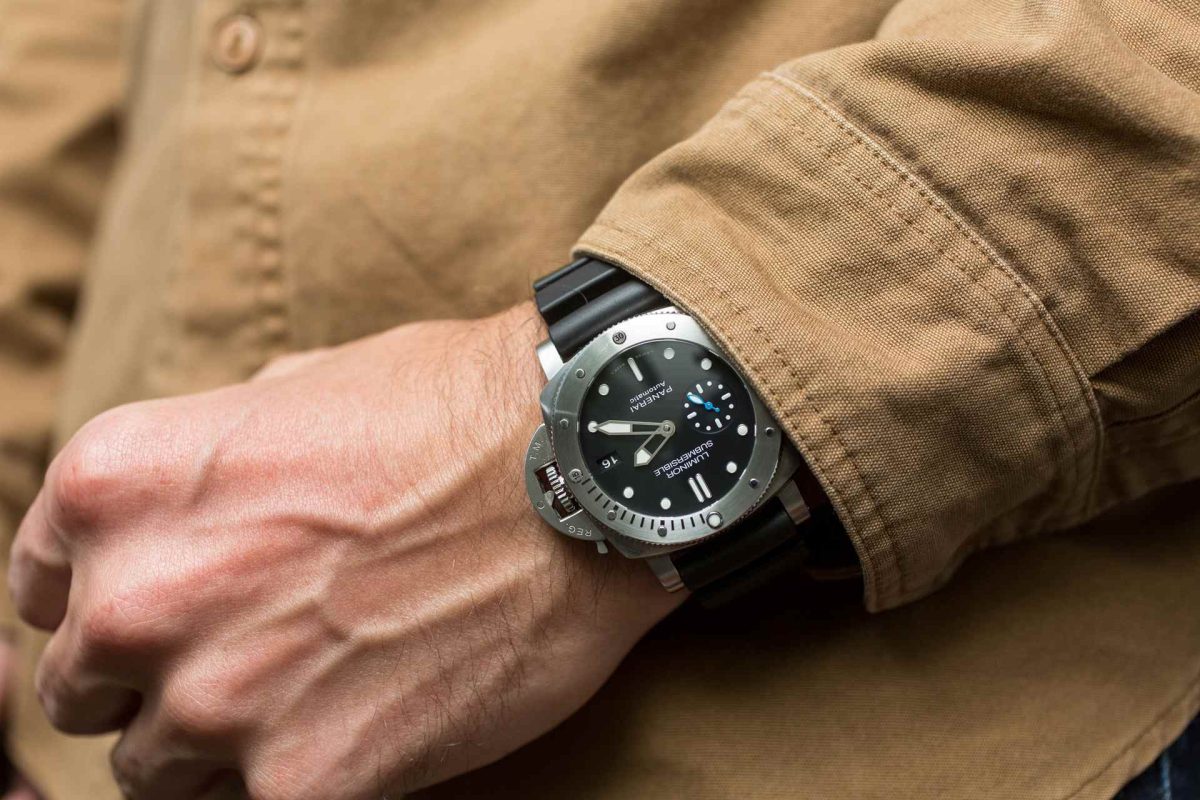
Panerai Luminor 1950 Replica — GMT, Power Reserve and Iconic Cases
Mar
Panerai Luminor 1950 Replica — GMT, Power Reserve and the Most Iconic Cases
The Luminor 1950 sits at the top of the Panerai food chain. Thicker lugs, a domed sapphire crystal with exhibition caseback, and that unmistakable cushion profile — this is the case shape that turned Panerai from a niche Italian brand into a global collector obsession. If you held a standard Luminor in one hand and a 1950 in the other, your fingers would know the difference before your eyes caught up.
I spent the better part of three years wearing nothing but 1950-case Panerais. Here is everything that matters about this case family — and which replicas actually nail the details.
In This Guide:
- Luminor 1950 vs Standard Luminor — Five Differences That Matter
- GMT Models — Second Timezone on Your Wrist
- 8 Days and 10 Days — Extended Power Reserve
- Material Editions — Bronzo, Ceramica, Titanium
- Best Panerai Luminor 1950 Replicas — What to Look For
- Internal Links
- Wearing the 1950 — Real-World Experience
- P.9000 vs P.9001 — Movement Differences in the 1950
Luminor 1950 vs Standard Luminor — Five Differences That Matter
People mix these up constantly. They share a name and a crown guard, but the 1950 case is a different animal. The original design dates back to a prototype Panerai built in the early 1950s for the Italian Navy — wider lugs, a more sculpted bridge, and a thicker mid-case.
| Feature | Standard Luminor | Luminor 1950 |
|---|---|---|
| Lugs | Shorter, straighter | Longer, curved downward |
| Crystal | Flat sapphire | Domed sapphire |
| Caseback | Solid steel | Sapphire display (most models) |
| Case middle | Straight sides | U-shaped, more sculpted |
| Crown guard marking | Plain | REG. T.M. engraved |
Tip: The sapphire caseback is the fastest tell. If you flip the watch and see the movement — it is a 1950 case. Standard Luminors have a solid steel back with engravings.
GMT Models — Second Timezone on Your Wrist
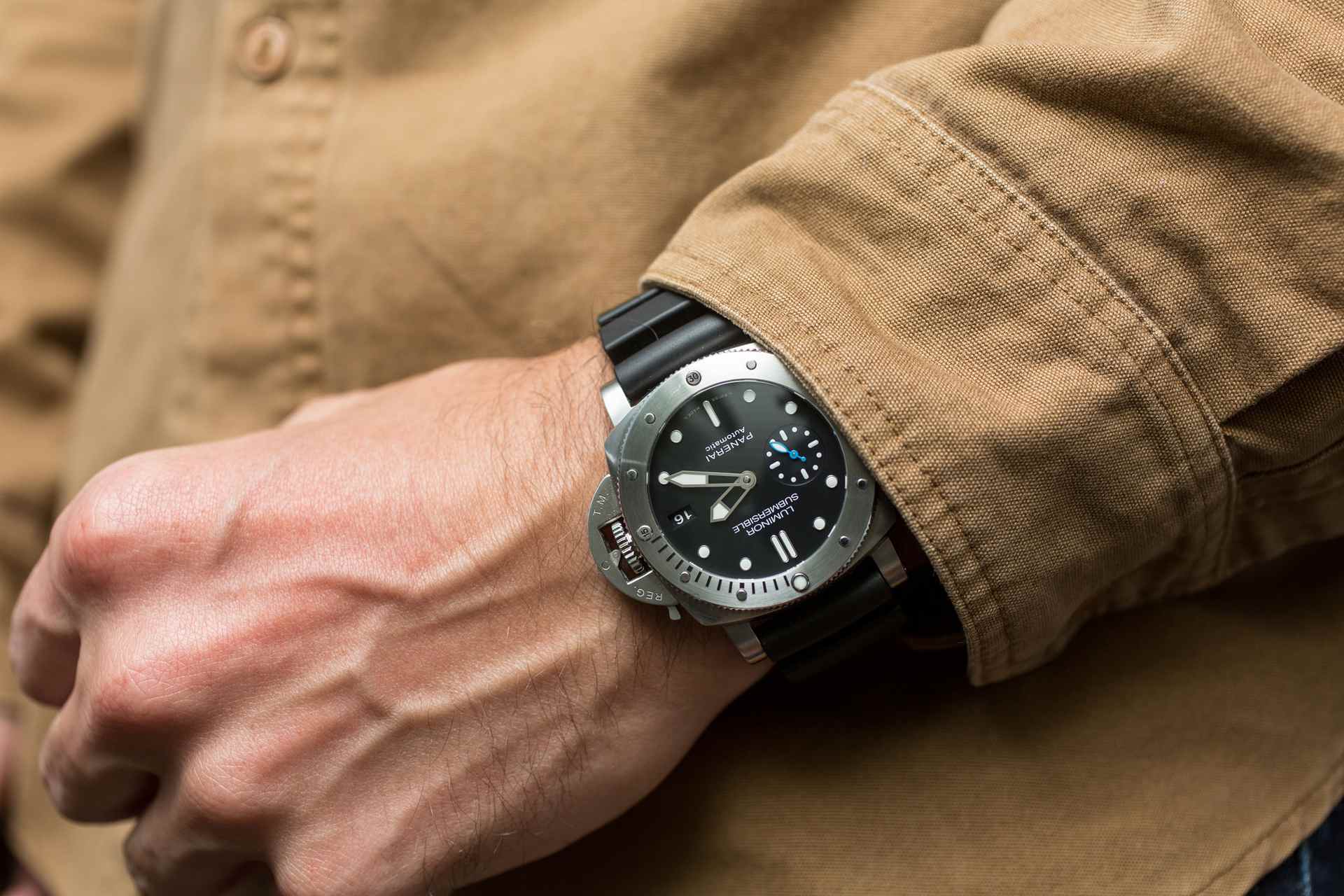
The GMT complication is where the Luminor 1950 really earns its keep. A fourth hand — usually an arrow — sweeps the dial once every 24 hours, showing a second timezone at a glance. For anyone who travels or works across time zones, it is the single most practical complication Panerai offers.
How to Set the GMT on a Panerai 1950 Replica
- Unscrew the crown guard and pull the crown to the first click position
- Rotate the crown clockwise — the hour hand moves independently in one-hour jumps while the GMT arrow stays fixed
- Set local time using the hour hand. The GMT arrow continues showing your home timezone
- Push the crown back and lock the crown guard
The key concept: your hour hand shows local time, the GMT arrow shows home time on the 24-hour scale. When you land in a new timezone, you adjust only the hour hand — minutes and seconds keep running without interruption.
Best GMT PAM References in the 1950 Case
| PAM | Name | Material | Size | Movement |
|---|---|---|---|---|
| PAM088 | Luminor GMT | Steel | 44mm | OP IX (ETA base) |
| PAM233 | 1950 GMT 8 Days | Steel | 44mm | P.2002 (8 days) |
| PAM441 | 1950 GMT Ceramica | Ceramic | 44mm | P.9001 |
| PAM531 | 1950 3 Days GMT 24H | Steel | 42mm | P.9003 |
| PAM1033 | Submersible GMT Carbotech | Carbotech | 47mm | P.9010 |
The PAM441 in black ceramic is the one collectors chase hardest. Monochrome case, minimal dial, and the P.9001 movement with bidirectional GMT adjustment — it does everything the PAM233 does but in a material that never scratches.
8 Days and 10 Days — Extended Power Reserve
Most automatic watches run for 42 to 72 hours on a full wind. Panerai decided that was not enough. The P.2002 and P.2003 calibers inside certain 1950 models deliver eight full days of power reserve — 192 hours. Wind it on Monday morning, leave it on your desk, and it is still ticking Saturday night.
The power reserve indicator sits at the 5 o’clock position on most 8-day models — a linear gauge that slowly drops over the week. On the 10-day models (like the P.2003), you get 240 hours from twin barrels, plus a GMT complication built in.
| Feature | Standard (P.9000) | 8 Days (P.2002) | 10 Days (P.2003) |
|---|---|---|---|
| Power reserve | 3 days (72h) | 8 days (192h) | 10 days (240h) |
| Winding | Automatic | Hand-wound | Hand-wound |
| GMT | Select models | Yes (most) | Yes |
| PR indicator | No | Linear at 5 o’clock | Linear at 5 o’clock |
| Barrels | 2 | 3 | 4 |
Insight: On replicas, the 8-day power reserve indicator is cosmetic — the clone movement runs about 48-52 hours. The indicator moves, but it does not track real power accurately. This is normal and expected for all clone calibers.
Material Editions — Bronzo, Ceramica, Titanium
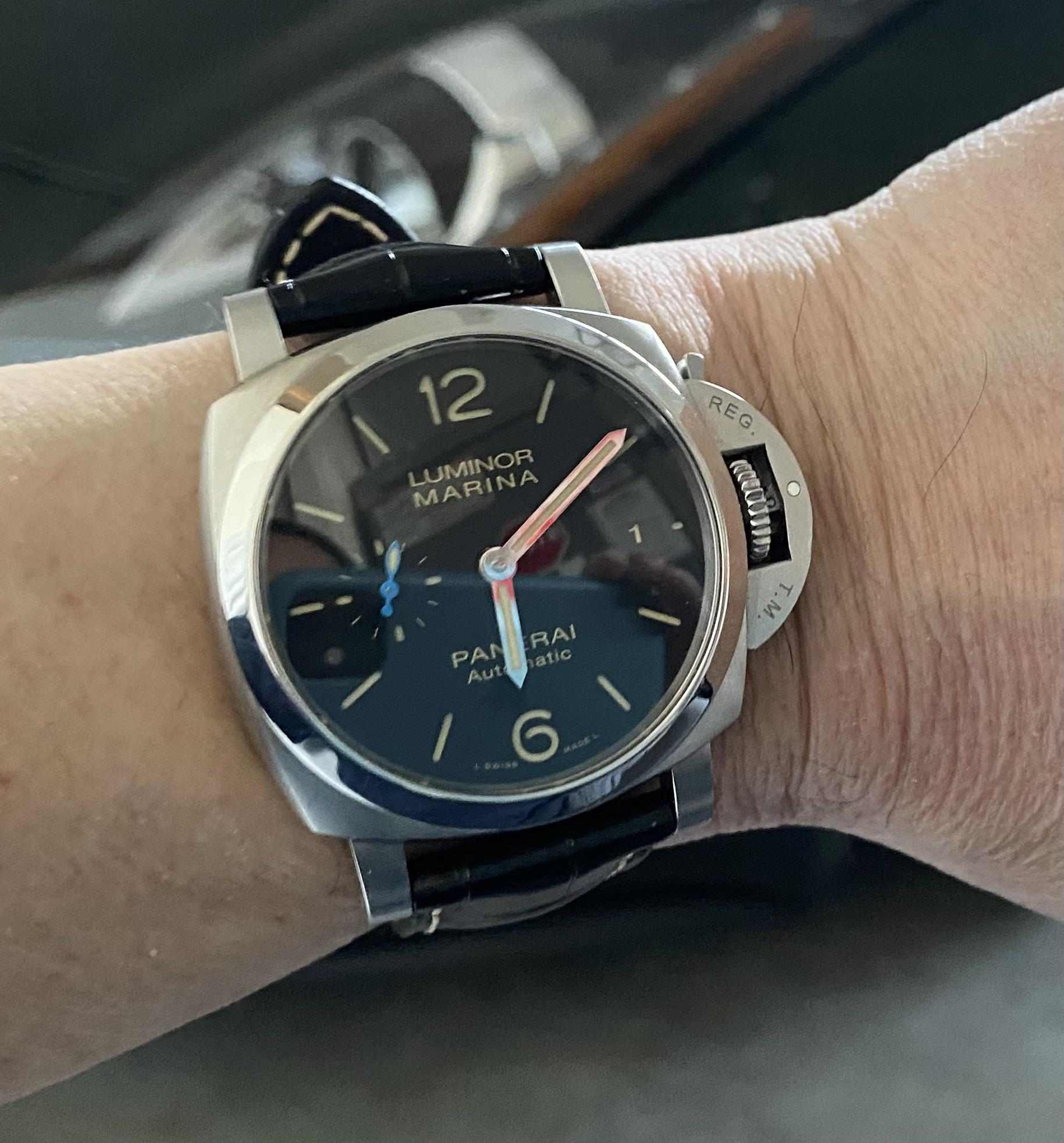
Panerai used the 1950 case as the platform for its wildest material experiments. The Bronzo (PAM382) kicked off the bronze watch craze across the entire industry. Ceramica models like the PAM441 proved that matte black ceramic could look aggressive and refined at the same time.
- Bronzo PAM382 — CuSn8 bronze that develops unique patina over months. No two watches age the same way
- Ceramica PAM441 — Zirconium oxide ceramic, virtually scratch-proof, 44mm GMT
- Titanium PAM351 — Grade 5 titanium, 30% lighter than steel, matte grey finish
- Carbotech PAM616 — Layered carbon fiber with irregular patterns, each piece unique
Best Panerai Luminor 1950 Replicas — What to Look For
The 1950 case is harder to replicate than the standard Luminor because of the curved lugs and domed crystal. Here is what separates a good 1950 replica from a bad one:
- Lug curve — must match the body contour, not stick out at odd angles
- Crystal dome — should be subtle, not a fish-eye bubble. AR coating inside only
- Caseback sapphire — the movement should be visible and the rotor decorated
- Crown guard depth — the REG. T.M. engraving must be crisp, not mushy
- Lume consistency — sandwich dials should glow evenly, no dead spots
VSF currently produces the most accurate 1950 cases. Their balance wheel placement at 7 o’clock matches the genuine P.9000/P.9001 layout — older factories had it at 6 or 11 o’clock, which was an immediate tell through the sapphire back.

Internal Links
For Swiss movement details inside these watches, read our Panerai replica Swiss movement guide. If you are choosing between case sizes, our size guide from 38mm to 47mm covers every option. And for the ceramic material science behind the PAM441, see our materials guide.
Wearing the 1950 — Real-World Experience
The Luminor 1950 case wears differently than it measures. On paper, a 44mm watch with 16mm thickness sounds unwearable for anyone with a wrist under 7.5 inches. In practice, the curved lugs pull the watch tight against your skin, and the U-shaped case middle distributes weight more evenly than the flat-sided standard Luminor.
I wore a PAM312 (1950 case, 44mm) daily for eight months. The crown guard never snagged on shirt cuffs — the lever sits flush when locked. The domed crystal catches light at angles that the flat-crystal Luminor misses entirely. And the sapphire caseback gives you something to look at during long meetings — the decorated rotor sweeping across the movement bridges becomes a private show.
One practical issue: the domed crystal is slightly more vulnerable to desk-diving impacts. A flat crystal spreads force across its entire surface. A dome concentrates it at the apex. If you work at a desk, the 1950 will collect micro-scratches on the crystal faster than a standard Luminor. Sapphire does not scratch easily, but it is not immune to direct hits against granite countertops or steel drawer handles.
P.9000 vs P.9001 — Movement Differences in the 1950
Both movements are in-house Panerai calibers, but they serve different purposes:
- P.9000 — time-only with date. Twin barrels, 72-hour reserve, bidirectional winding. Used in PAM312, PAM1312, and most non-GMT 1950 models. The workhorse
- P.9001 — adds GMT function. Same twin-barrel architecture but with an additional gear train for the 24-hour hand. Used in PAM441, PAM1033. The traveler’s choice
- P.9010 — compact version of P.9000 for smaller cases (42mm). Same 72-hour reserve in a thinner package. Used in PAM1392, PAM1085
On clone movements, the P.9000 and P.9001 share the same base platform with the GMT module added or removed. The key quality marker remains the balance wheel at 7 o’clock — if your replica has it there, the movement was built to VSF specifications regardless of which caliber designation appears on the rotor.
For travel, the P.9001 GMT is worth the premium. Adjusting timezones with the independent hour hand — no crown fuss, no minute/second disruption — turns a 30-second airport ritual into something almost pleasant.
Frequently Asked Questions
What is the difference between Luminor and Luminor 1950?
The 1950 has longer curved lugs, a domed crystal, sapphire display caseback, U-shaped case middle, and REG. T.M. marking on the crown guard. The standard Luminor has shorter lugs, flat crystal, and solid caseback.
How do I set the GMT on a Panerai 1950 replica?
Pull the crown to the first position and rotate clockwise. The hour hand jumps in one-hour steps while the GMT arrow stays fixed on your home timezone. Push crown back and lock the guard when done.
What is the 8-day power reserve and which models have it?
The P.2002 caliber stores energy in three mainspring barrels for 192 hours (8 days). Key models: PAM233, PAM311, PAM368. The 10-day P.2003 uses four barrels for 240 hours in models like PAM270 and PAM533.
Is the Luminor 1950 case thicker than the standard Luminor?
Yes. The 1950 case is typically 15.5-16mm thick versus 14-15mm for the standard Luminor. The domed crystal and display caseback add about 1mm of height. On wrist, the curved lugs make it sit flatter despite being thicker.
Which Panerai 1950 GMT replica is the best?
The PAM441 Ceramica GMT from VSF is considered the benchmark — scratch-proof ceramic case, correct P.9001 clone with balance at 7 o’clock, and the matte black aesthetic that photographs well and wears even better.