

Panerai News
Panerai Flyback, Regatta and Chronograph Replicas — Racing Complications Explained
Mar
Panerai Flyback, Regatta and Chronograph Replicas — Racing Complications Explained
Most Panerai watches show hours, minutes, and maybe a second timezone. The chronograph models break that pattern with stopwatch functions, split-second timing, and countdown mechanisms designed for yacht races. These are the most mechanically ambitious watches Panerai makes — and the ones that confuse replica buyers the most.
Three questions keep showing up: Does the chronograph actually work on a replica? What is a flyback? And is the rattrapante complication real or just decoration? Let me answer all of them.
In This Guide:
- What Is a Flyback Chronograph
- Rattrapante — The Most Complex Panerai Complication
- Regatta Countdown — Built for Yacht Racing
- Daylight — The Sport Chronograph
- Do Chronograph Functions Actually Work on Replicas?
- Best Chronograph PAM References for Replicas
- Chronograph Movement Teardown — What Is Inside
- How to Use the Chronograph — Step by Step
What Is a Flyback Chronograph
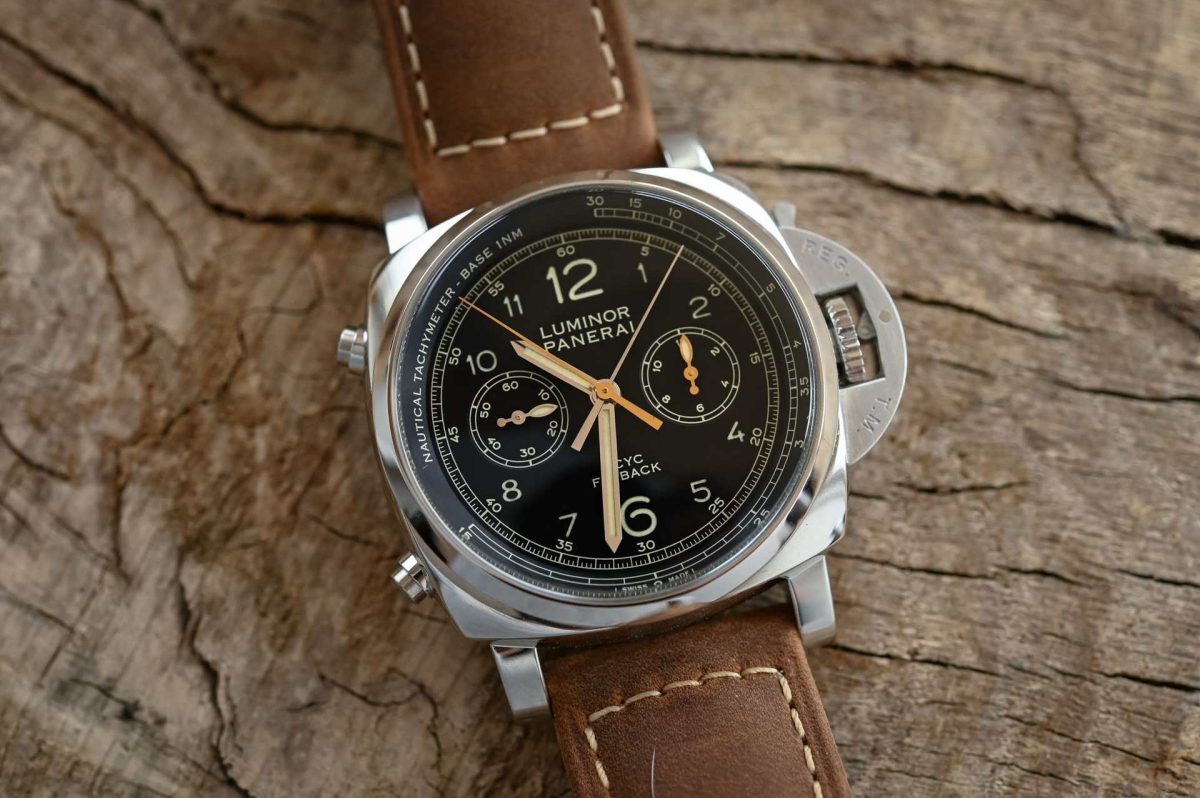
A standard chronograph requires three steps to restart timing: stop, reset, start. A flyback eliminates two of those steps. You press the reset pusher while the chronograph is running, and the seconds hand instantly snaps back to zero and starts counting again — one press instead of three. The French call it “retour en vol” because pilots needed to time consecutive navigation legs without losing seconds between resets.
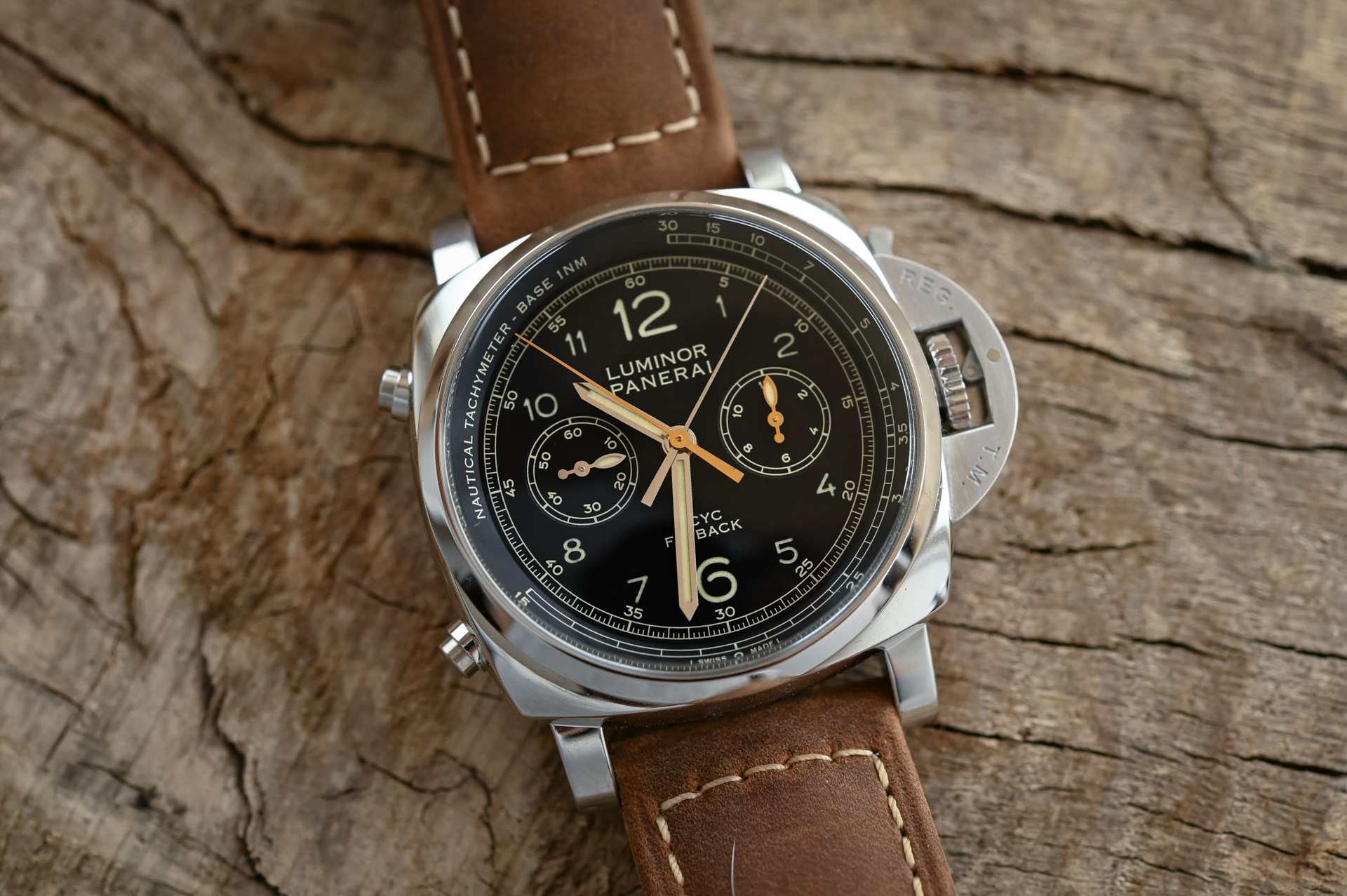
Panerai uses the flyback in its Luminor Chrono Flyback series. The most common references are the PAM212 (44mm steel) and the PAM1498 (44mm with the newer case design). Both use column-wheel chronograph movements — the mechanism that makes the start-stop-reset action feel smooth rather than crunchy.
Practical note: On quality replicas, the flyback function works. You can press the reset pusher during a running chronograph and the hand snaps back to zero and restarts. The column-wheel inside is a simplified version, but the end result looks and feels correct.
Rattrapante — The Most Complex Panerai Complication
Rattrapante means “split seconds” in Italian. Two chronograph hands stack on top of each other. Start the chronograph and both hands sweep together. Press the split pusher and one hand freezes to record an intermediate time while the other keeps running. Press the split pusher again and the frozen hand catches up to the running hand instantly. This lets you time two events that start together but end at different moments.
In the watch world, the rattrapante is one of the hardest complications to build. It requires an entire second gear train running parallel to the chronograph, plus a clamp mechanism to stop one hand without affecting the other.
| Complication | What It Does | Button Presses to Restart | Key PAM Models |
|---|---|---|---|
| Standard Chrono | Stopwatch: start, stop, reset | 3 presses | PAM074, PAM162 |
| Flyback | Instant reset + restart | 1 press | PAM212, PAM1498 |
| Rattrapante | Split-seconds timing | Separate split pusher | PAM332, PAM530 |
| Regatta | Countdown for yacht races | Crown + pushers | PAM332, PAM526 |
Regatta Countdown — Built for Yacht Racing
Yacht races start with a countdown sequence — typically five minutes, then four, then one, then go. The regatta complication adds a countdown function to the chronograph. A separate hand on a subdial counts backward from a preset time (usually programmable in one-minute increments up to 15 minutes) so the helmsman knows exactly when to cross the start line.
Panerai combines the regatta function with the rattrapante in their most spectacular models. The PAM332 (Luminor 1950 Regatta Rattrapante) does both: countdown timing for the race start, plus split-second chronograph for individual lap times. It is the most complicated watch Panerai has ever produced in the Luminor case.
Daylight — The Sport Chronograph
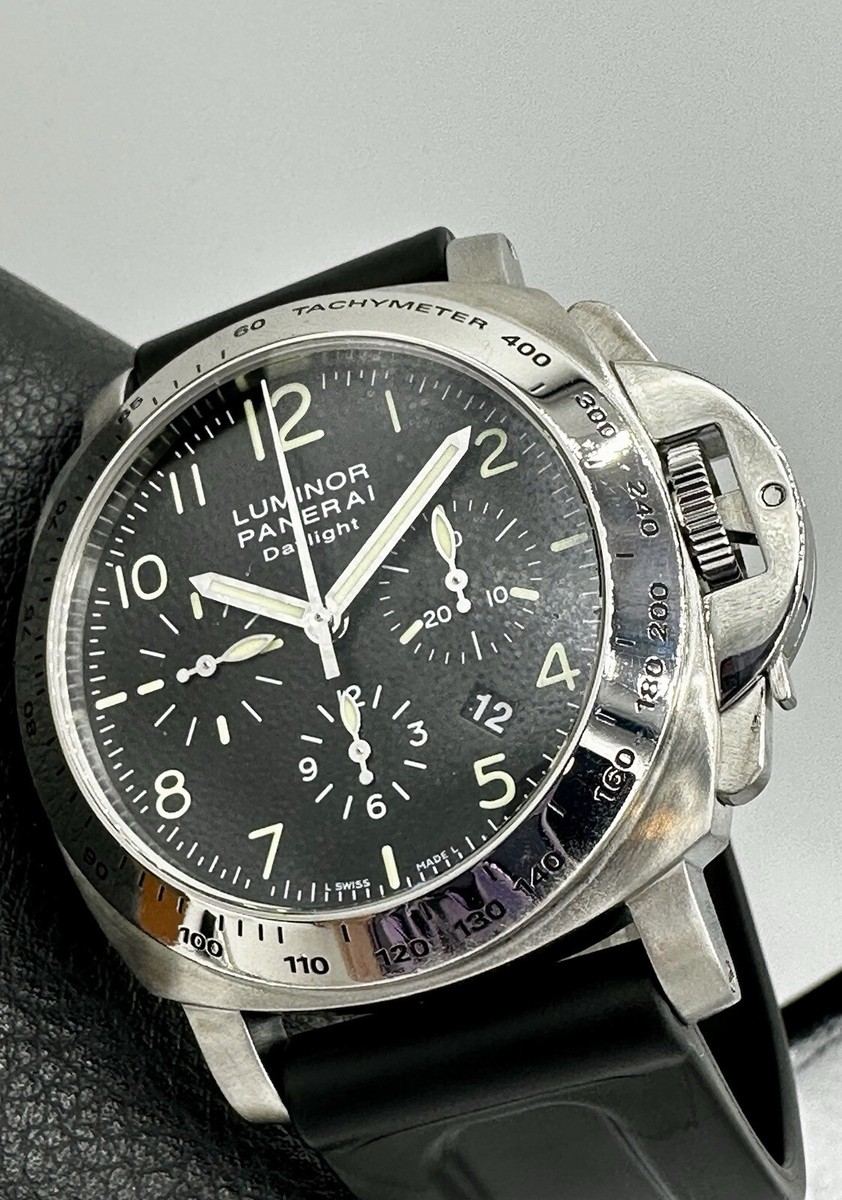
The Luminor Daylight (PAM196, PAM250, PAM356) is Panerai’s entry-level chronograph. Named for its high-visibility dial layout, the Daylight puts two subdials at 3 and 9 o’clock — running seconds and elapsed minutes — with a date window at 4 o’clock. It is the easiest chronograph Panerai to read at a glance.
The Daylight models use a Valjoux 7750 base movement (or its clone in replicas), which is the workhorse of the Swiss chronograph world. The 7750 has been in production since 1974, and parts availability for servicing is excellent — even for replicas.
Do Chronograph Functions Actually Work on Replicas?
Yes, with caveats:
- Start/stop/reset — works on all quality replicas. The central seconds hand runs, stops, and resets correctly
- Subdials — the running seconds subdial works. The elapsed minutes subdial works on most models. The elapsed hours subdial (if present) sometimes does not advance on budget replicas
- Flyback — works on quality replicas with proper column-wheel movements. Budget replicas may lack real flyback function
- Rattrapante — partial function. The split pusher typically freezes the seconds hand, but the catch-up snap is not always smooth. This is the one complication where replicas struggle most
Warning: Running the chronograph continuously drains power faster. On a replica with 40-48 hours of reserve, leaving the chronograph running overnight can stop the watch. Use the chronograph for timing events, then reset it.
Best Chronograph PAM References for Replicas
| PAM | Name | Complication | Size | Works on Replica? |
|---|---|---|---|---|
| PAM196 | Luminor Daylight | Chronograph | 44mm | Yes — all functions |
| PAM212 | Luminor Chrono Flyback | Flyback | 44mm | Yes — flyback works |
| PAM332 | 1950 Regatta Rattrapante | Regatta + Rattrapante | 47mm | Partial — split limited |
| PAM356 | Luminor Daylight Chrono | Chronograph | 44mm | Yes — all functions |
| PAM1498 | Luminor Chrono Flyback | Flyback | 44mm | Yes — flyback works |
Want to understand the movements inside these chronographs? Read our Swiss movement guide. For the materials used in special chronograph editions, see our materials guide.
Chronograph Movement Teardown — What Is Inside
Most Panerai chronograph replicas use a clone of the Valjoux 7750 movement — the same caliber base found in TAG Heuer, Breitling, and IWC chronographs. The 7750 has been in production since 1974, making it one of the most reliable and well-understood automatic chronograph platforms in existence.
Key characteristics of the 7750 clone in Panerai chronograph replicas:
- Automatic winding with a unidirectional rotor — winds in one direction only, which reduces efficiency compared to bidirectional but simplifies construction
- 28,800 vibrations per hour (4Hz beat rate) — the chronograph seconds hand moves in smooth sweeps, not ticks
- 42-48 hours power reserve — enough for two days of continuous wear
- Day-date complication on some models — day at 9 o’clock, date at 3 o’clock (hidden behind subdials on Panerai dials)
- Column wheel vs cam lever — higher-quality replicas use a column-wheel mechanism for smoother pusher action. Budget versions use cam levers that feel noticeably stiffer when pressing the start/stop buttons
The 7750 has one quirk that experienced watch people recognize: the automatic rotor has a distinct wobble sound when you shake the watch. This is normal for the 7750 architecture and is not a defect — the heavy rotor on its ball bearing creates more inertia than a smaller movement would.
How to Use the Chronograph — Step by Step
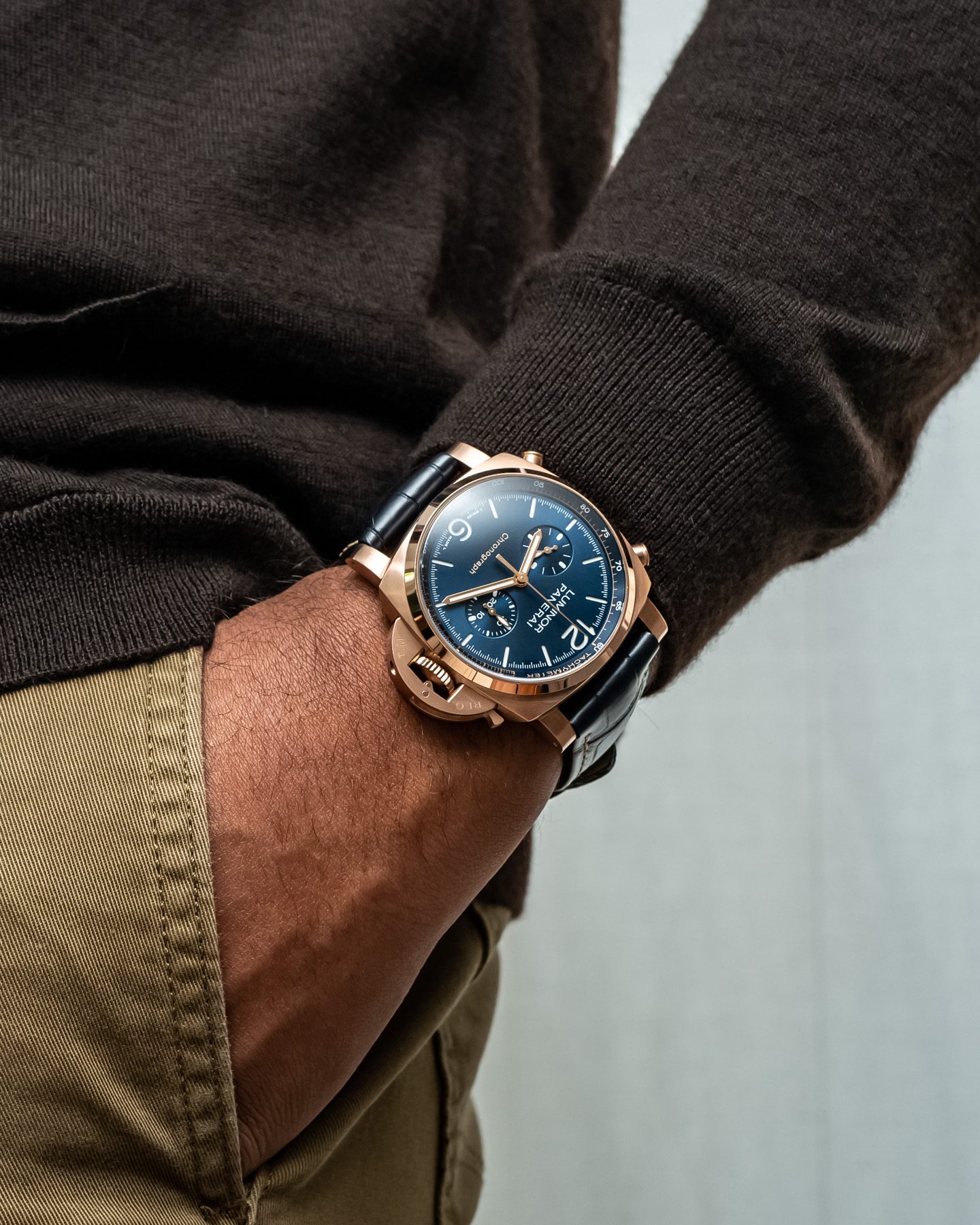
If you have never operated a chronograph watch before, here is the basic sequence. Panerai chronographs have two pushers — one at 2 o’clock (top) and one at 4 o’clock (bottom):
- Press top pusher (2 o’clock) — starts the chronograph. The central seconds hand begins sweeping
- Press top pusher again — stops the chronograph. Read the elapsed time from the seconds hand and the minutes subdial
- Press bottom pusher (4 o’clock) — resets everything to zero. Both the central seconds and subdial hands snap back
For flyback models, you can skip step 2 entirely. While the chronograph is running, press the bottom pusher — the seconds hand snaps to zero and immediately starts again. One press instead of three. This is what makes flyback valuable for consecutive timing.
Tip: Never adjust the time or date while the chronograph is running. Stop and reset the chronograph first, then pull the crown to change settings. Operating the crown and chronograph simultaneously can damage the movement coupling mechanism.
For understanding the movements powering these chronographs, read our complete Swiss movement guide. And if you want to know which size chronograph fits your wrist, check the size guide.
Frequently Asked Questions
Does the chronograph actually work on a Panerai replica?
Yes. Start, stop, and reset functions work on all quality replicas. The central seconds hand, elapsed minutes subdial, and running seconds subdial all operate correctly. Budget replicas may have non-functional hour counters.
What is the difference between flyback and rattrapante?
Flyback resets and restarts the chronograph with one button press instead of three. Rattrapante (split-seconds) uses two stacked hands — one can freeze to record an intermediate time while the other keeps running. Flyback is about speed of resetting. Rattrapante is about timing two events.
Which Panerai Regatta replica is the most accurate?
The PAM332 Regatta Rattrapante is the most complex but also the hardest to replicate accurately. For reliable function, the PAM212 Flyback is a safer choice — the flyback mechanism works correctly on quality replicas and the visual impact is strong.
What is the Panerai Daylight chronograph?
The Daylight series (PAM196, PAM250, PAM356) is Panerai’s sport chronograph with two subdials at 3 and 9 o’clock. It uses a Valjoux 7750 movement base — the most widely produced and serviceable Swiss chronograph caliber.
Can you time events with a replica chronograph?
Absolutely. The chronograph seconds hand sweeps smoothly and the elapsed minutes counter tracks correctly. Accuracy is within 1-2 seconds per hour of timing — more than enough for cooking, parking, or casual sports timing.